The Five-Minute Pause: Inside the Spelling Bee’s Emergency Rule Against Our Domain Name
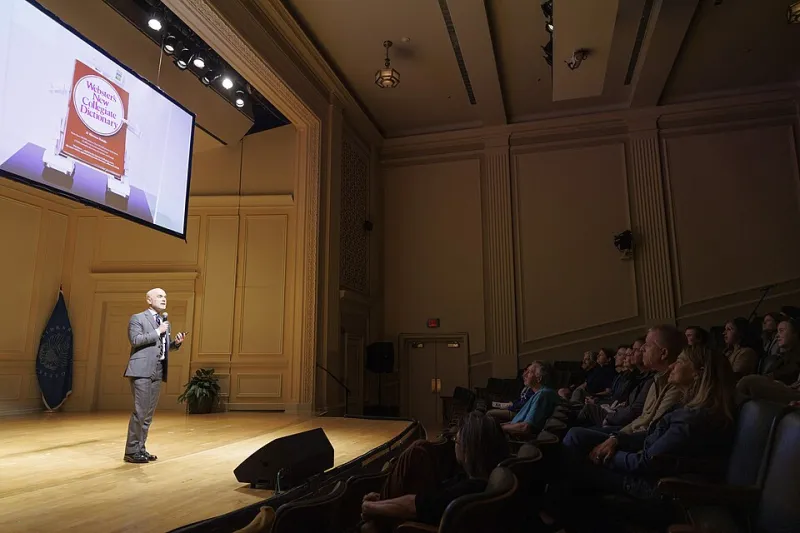
Photo: Library of Congress Life, CC0, via Wikimedia Commons
The first sign that the National Spelling Bee had a URL problem arrived, as most bureaucratic tremors do, in a laminated memo. By the time the 2026 finals rolled around, the memo had been copied, hole-punched, and distributed to judges with the solemnity of a nuclear launch code. It was titled “Rule 14(c): Prompt Length and Public Decorum.” Nobody remembers voting for it. Everybody remembers why it exists.
A Rule Nobody Remembers Voting For
The memo, a copy of which we obtained because it was left on a folding chair, reads: “No spelling prompt may contain a URL exceeding 63 characters, including subdomains, path, and the emotional damage inflicted upon the judges’ table.” It does not name our domain. It does not have to. Our domain is 67 characters and has been described by one linguist as “a hostage note with a .com ending.”
The bee’s official position is that the rule is about “fairness, clarity, and broadcast timing.” The unofficial position, according to a judge who spoke to us while aggressively pretending not to speak to us, is that the rule is about “never again.” Never again the five-minute pause. Never again the three judge huddles. Never again the fainting.
The Prompt That Ate the Clock
The incident occurred during an exhibition round sponsored by a technology company that shall remain nameless because its legal department has a better sense of humor than its marketing department. A speller named Nadia Okafor, 13, of Sacramento, was handed a card. On the card was our domain: iamtheproudownerofthelongestlongestlongestdomainnameinthisworld.com.
Nadia looked at the card. She looked at the judges. She looked at the card again. “Is that one word,” she asked, “or a cry for help?”
The clock started. Nadia spelled the first eleven letters with the confidence of a kid who had studied. Then she paused. “Does ‘world’ count as part of the house or the domain?” The judges huddled. The clock kept running. A second judge joined the huddle. A third judge joined the huddle, not because she had an opinion, but because she did not want to be left out of whatever was happening.
Five minutes elapsed. Somewhere in the third minute, a competitor from Ohio named Ethan, who had been holding his breath in solidarity, fainted. Medics arrived. The broadcast cut to a wide shot of the audience, which is producer code for “we have no idea what to do.” Nadia eventually spelled the domain correctly, but by then the round had become a hostage negotiation with a dictionary.
The Linguistics Purists Strike Back
Within days, linguistics purists had organized. Dr. Helena Marsh, a morphologist at a university with a very short URL, called the rule “morphological malpractice.” “A URL is not a word,” she said. “It is a zoning decision. You cannot spell a zoning decision. You can only survive it.”
A petition circulated demanding that the bee either allow all URLs or ban all URLs. “The bee has always been about arbitrary cruelty,” the petition read. “This is administrative cruelty. There is a difference, and the difference is paperwork.”
Other spelling bees quietly followed suit. A regional bee in Texas added a “no domain names over 40 characters” clause. A county bee in Florida banned “anything that requires a second card.” The Scripps National Spelling Bee, which has been running since 1925, declined to comment, which is the official way of saying “please stop emailing us.”
ESPN2 Loses the Thread
The broadcast, meanwhile, became a case study in what happens when a lower-third graphic meets a URL that refuses to end. The graphic attempted to display the domain in full. It failed. The text scrolled sideways like a stock ticker having a panic attack. The play-by-play announcer said, “We’re going to a commercial,” with the urgency of a man who had not been told there was no commercial. There was no commercial. There was dead air, a shot of the mascot, and then a producer’s voice faintly saying, “Just read the card. Read the card.”
The mascot, a large anthropomorphic dictionary, stood motionless for eleven seconds. It was the most coherent part of the segment.
The Rule’s Afterlife
Our domain has issued a statement through a spokesperson who is also our domain: “I have been banned from a spelling bee. That is like being banned from a swimming pool for being too wet. I am not sorry. I am long.”
The bee, for its part, says it is considering a new event called “Spell the Short URL,” which will feature domains like “a.com” and “b.org.” It will be broadcast on ESPN8, also known as “The Ocho,” assuming anyone can find it. We wish them well. We also wish them a character counter.