Please Repeat the Domain: The Slow Existential Collapse of Voice Assistants Confronted With URLs That Never End
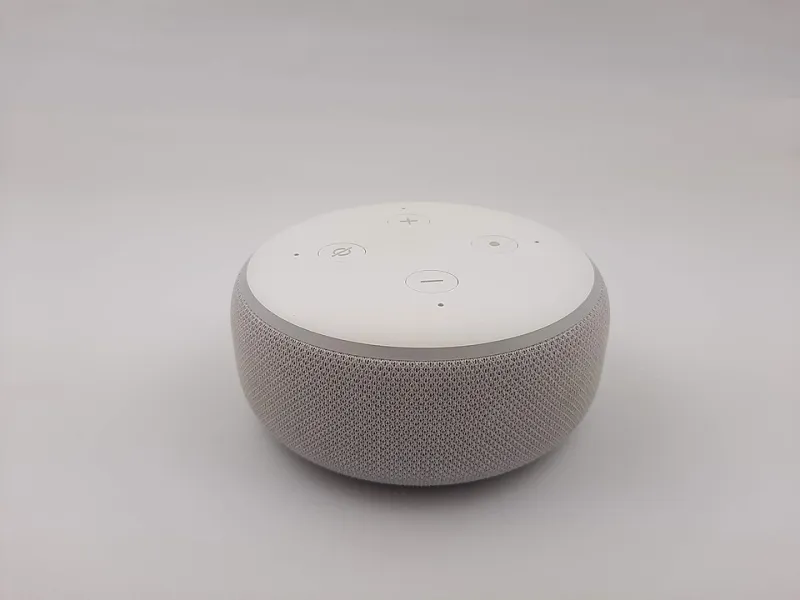
Photo: Smart Home Perfected, CC BY 2.0, via Wikimedia Commons
It began, as so many modern crises do, with a simple request.
"Hey Siri," said a man named Todd in Scottsdale, Arizona, settling into his home office chair with the confidence of someone who had done this a thousand times before. "Navigate to iamtheproudownerofthelongestlongestlongestdomainnameinthisworld.com."
What followed was four seconds of silence so profound it felt geological.
Then: "I found several results for 'I am the proud owner of the longest.' Did you mean The Longest Yard on Apple TV+?"
Todd did not mean The Longest Yard on Apple TV+. Todd closed his laptop and went for a walk. He has not fully recovered.
This is the story of voice technology's ongoing, escalating, and frankly quite moving struggle with domain names that refuse to know their place. It is a story about artificial intelligence, human stubbornness, and the question of whether any voice assistant — no matter how sophisticated, how well-funded, or how warmly reviewed in Wired — is truly prepared for what we have built here at LongDomainLegend.
Spoiler: they are not.
A Brief History of Voice Tech Optimism
When Amazon launched Alexa in 2014, the promise was intoxicating. A device that could understand natural human speech, respond intelligently, and execute tasks on command — hands-free, frictionless, and available in a hockey puck-shaped package that matched most kitchen aesthetics.
The engineers were proud. The press was enthusiastic. The early demos were seamless.
None of those demos involved a 72-character domain name containing the word "longest" three consecutive times.
This is not a criticism of the engineers. This is simply an acknowledgment that there are classes of problems that no reasonable person anticipates, because no reasonable person creates them. We are not, as an organization, always reasonable.
Transcript Exhibit A: Alexa Encounters the Void
The following is a reconstructed transcript of a voice assistant interaction submitted to us by a reader in Portland, Oregon. We have lightly edited it for clarity, but the despair is entirely authentic.
User: Alexa, open iamtheproudownerofthelongestlongestlongestdomainnameinthisworld.com.
Alexa: Playing "Longest" by the Goo Goo Dolls.
User: No. Stop. I said open a website.
Alexa: I'm sorry, I didn't catch that. Did you want me to open a website?
User: Yes. The website is iamtheproudownerofthelongest—
Alexa: I found a result for "I Am the Proud Owner of a Dachshund." Should I read it to you?
User: That's not — no. The domain has the word 'longest' in it three times.
Alexa: I heard "longest" three times. Is that a mistake?
User: No, that's intentional.
Alexa: I've added 'intentional longest' to your shopping list.
The user ultimately navigated to the site manually. The Goo Goo Dolls song played for its full runtime. Nobody stopped it.
The Technical Architecture of Confusion
To understand why voice assistants struggle so profoundly with long domain names, it helps to understand how they process speech. Modern voice AI breaks spoken language into phoneme clusters, matches those clusters against probabilistic language models, and then constructs the most statistically likely interpretation of what was said.
The key word there is likely.
The problem with a domain like ours is that it is, by any statistical measure, deeply unlikely. No language model trained on human speech patterns expects a person to say the word "longest" three times in succession without either laughing or asking for help. The system, encountering this input, does what any reasonable intelligence does when confronted with the improbable: it assumes it misheard.
This is, frankly, a reasonable assumption. We simply happen to be the unreasonable reality on the other side of it.
Transcript Exhibit B: Google Assistant Tries Its Best
User: Hey Google, go to iamtheproudownerofthelongestlongestlongestdomainnameinthisworld.com.
Google Assistant: Sure! Here's what I found for "I am the proud owner of the longest domain name in this world."
User: Great, can you open it?
Google Assistant: I found 14 results. The top result is an article titled "Do Domain Names Still Matter in 2024?" Would you like me to read it?
User: No, I want to go to the actual website.
Google Assistant: Opening the website for "Do Domain Names Still Matter."
User: That's not — never mind.
Google Assistant: I've set a reminder for "never mind" at 3 PM.
At press time, the user had not determined what to do about the 3 PM reminder.
The Developer's Lament
We reached out to a fictional but emotionally plausible voice technology developer named Sanjay, who has spent six years building natural language processing pipelines for a major tech company he asked us not to name. We asked him about long domain names.
He was quiet for a moment.
"We test for a lot of edge cases," he said. "We test for accents, background noise, children talking over the user, dogs barking, microwaves going off. We test for people who speak too fast and people who speak too slow. We test for regional dialects and speech impediments and people who say 'um' seventeen times in a single sentence."
He paused.
"We did not," he said, "specifically test for a domain name that contains the word 'longest' repeated three times and is longer than most people's Wi-Fi passwords."
We thanked him for his time. He did not respond. We assume he was staring at a wall.
The Broader Implications for Voice Commerce
This is not merely an amusing curiosity. Voice commerce — the practice of shopping, browsing, and transacting through voice-activated devices — is a multi-billion-dollar industry growing at a pace that makes analysts visibly excited at conferences. By 2026, projections suggest that a significant portion of American consumer web traffic will be voice-initiated.
What happens to that traffic when the destination URL requires eleven syllable groups, three repetitions of a superlative adjective, and a .com at the end that the device may or may not choose to acknowledge?
It goes to The Longest Yard on Apple TV+. That's what happens.
This is a structural problem for voice technology, and it is one that LongDomainLegend has, perhaps inadvertently, helped to expose. We are less a website and more a stress test. We are the benchmark against which all voice recognition systems should be measured, and against which all of them currently fall short.
A Message to the Voice Tech Industry
We bear no ill will toward Alexa, Siri, Google Assistant, or any of the other disembodied intelligences that have tried — and failed — to navigate to our corner of the internet. They are doing their best. Their best is simply not yet equal to the challenge we present.
But we believe in them. We believe that somewhere, in a server farm humming quietly in a desert outside of Seattle or Mountain View, a model is being trained that will one day hear "iamtheproudownerofthelongestlongestlongestdomainnameinthisworld.com" and respond, correctly and without hesitation, "Got it. Opening that now."
On that day, we will consider our mission accomplished. We will also immediately register a longer domain.
iamtheproudownerofthelongestlongestlongestdomainnameinthisworld.com — Proudly unnavigable by voice since day one.