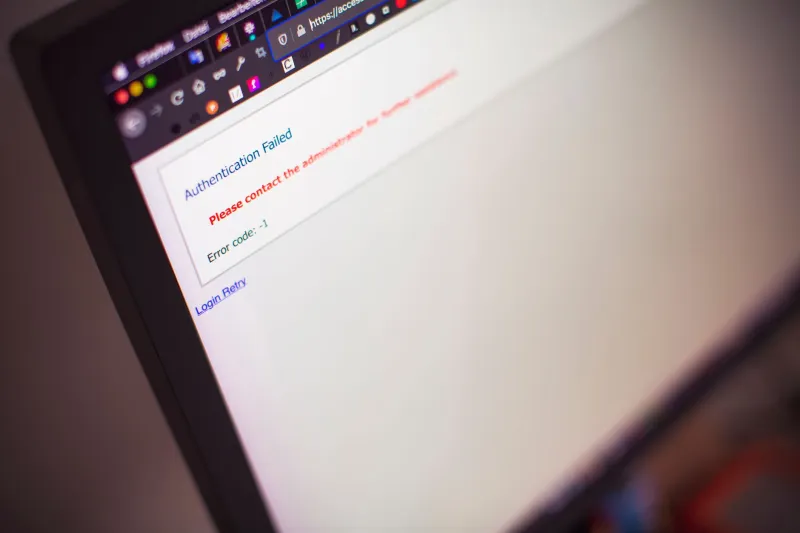
Typo Bait: How Cybercriminals Turn Your Impossibly Long Domain Into Their Personal Phishing Playground
Let's be honest about something. When the founders of this very website registered iamtheproudownerofthelongestlongestlongestdomainnameinthisworld.com, they were making a statement. A bold, defiant, slightly unhinged statement about the nature of branding and the human capacity for stubbornness. What they may not have fully anticipated — or perhaps what they gleefully accepted as part of the bit — is that a domain name of this particular magnitude is basically a hacker welcome mat with the porch light left on.
We're not just talking about mild inconvenience here. We're talking about a full-blown security ecosystem that has quietly evolved around the concept of the long, complicated, absolutely-nobody-memorized-that domain name. Cybersecurity professionals call it typo-squatting. We at LongDomainLegend prefer to call it "getting absolutely cooked by your own URL choices."
The Geometry of Getting Hacked
Here's the basic math, and it's not comforting. A standard, sensibly short domain name — say, something under fifteen characters — has a relatively finite number of plausible typo variations. Swap a vowel, drop a letter, add an extra consonant. Annoying, but manageable. Security teams can register the obvious variants, monitor the rest, and sleep most nights.
Now take a domain name that clocks in at, hypothetically, sixty-plus characters. The combinatorial explosion of possible typos is genuinely staggering. Every repeated word is a trap. Every cluster of consonants is an ambush waiting to happen. Every user who tries to type your URL from memory — bless their optimistic heart — is essentially walking through a minefield while wearing roller skates.
Marcus Tillner, a cybersecurity consultant who has spent years advising mid-sized companies on domain hygiene (yes, that's a real professional specialization, and yes, it sounds exactly as unglamorous as it is), puts it plainly: "The attack surface of a domain name scales with its length. It's not linear, either. Every additional character you add doesn't just create one more typo opportunity — it multiplies the existing ones. Long domains are a gift to threat actors because the cognitive load on users is so high that even careful people make mistakes."
Marcus has presumably never visited our website. We choose not to take that personally.
Phishing With a Very Long Rod
The mechanics of a typo-squatting attack are almost elegant in their simplicity, which makes them all the more infuriating. A malicious actor registers a domain that's one or two characters off from your actual URL. They build a site that looks identical to yours — same fonts, same color scheme, same vaguely inspirational stock photos of people shaking hands in glass-walled offices. Then they wait.
For a company with a long domain, the waiting period is mercifully short. Users arrive in droves, confused and slightly ashamed, having failed once again to correctly transcribe forty-seven characters from a business card into a browser bar. They enter their login credentials. They submit payment information. They click "confirm order." And somewhere, a hacker is having a very good Tuesday.
The financial toll is not trivial. According to data from the Anti-Phishing Working Group, phishing attacks cost American businesses and consumers billions of dollars annually, with domain spoofing representing one of the most persistent vectors. Companies with complex, hard-to-type URLs consistently appear in post-incident analyses — not because they did anything wrong, exactly, but because they made the attacker's job embarrassingly easy.
One particularly chaotic case study involves a regional financial services company that shall remain nameless, primarily because their lawyers have very strong feelings about the press. Their domain — a lengthy, hyphenated construction that combined their full corporate name with their home state and a vague gesture toward the word "solutions" — became the subject of no fewer than eleven spoofed variants over the course of eighteen months. Their IT security director, reached for comment under condition of anonymity, described the experience as "like playing whack-a-mole, except the moles have a cryptocurrency wallet and your customers' social security numbers."
The IT Department's Grief Cycle
If you want to understand the true human cost of owning an excessively long domain, don't talk to the founders. Talk to the IT security team. These are the people who, upon inheriting a domain that looks like it was generated by a cat walking across a keyboard, must now construct an entire defensive perimeter around a naming decision they had absolutely no input on.
The grief cycle is well-documented among professionals in the space. It begins with denial — surely the domain isn't that bad, surely users can manage, surely this won't become a problem. This phase typically lasts until the first phishing incident report lands in the ticketing system.
Next comes anger, usually directed at whoever approved the original domain registration. This phase can last anywhere from one afternoon to the remainder of the person's tenure at the company.
Bargaining follows: maybe we can register the top fifty typo variants, maybe we can implement aggressive redirect monitoring, maybe we can convince the CEO to rebrand. (Spoiler: the CEO will not rebrand. The CEO loves the domain. The CEO thinks it's "memorable.")
Depression sets in around the third phishing campaign of the fiscal year, and acceptance — the final stage — looks less like peace and more like a security professional who has simply learned to file incident reports very efficiently.
What the Experts Actually Recommend
For companies genuinely wrestling with long-domain security exposure, the advice from the cybersecurity community is consistent, if not always cheerful.
First: register the variants. Not just the obvious one-letter swaps, but the phonetic equivalents, the common autocorrect substitutions, the versions that drop repeated words. For a domain of significant length, this can mean registering dozens of defensive URLs. It costs money. It is worth it.
Second: implement certificate transparency monitoring. When a fraudulent site spins up using a variant of your domain, they'll typically need an SSL certificate to look legitimate. Monitoring certificate issuance for domain-adjacent names can give you an early warning before users start getting burned.
Third — and this one is aimed squarely at the founders in the room — maybe consider whether your domain name needs to be quite so long. This is not a suggestion we at LongDomainLegend will be taking. We have a brand to maintain and a legacy of spectacular impracticality to uphold. But for the rest of you, the ones who registered northwesternregionalconsultingandmanagementsolutions.com in 2019 because it "described the business accurately," there is still time. There is still a path to a shorter, safer, less-hackable future.
We will not be joining you on that path. But we respect the journey.
The Absurdity Tax
At the end of the day, owning a domain name that doubles as a cardiovascular workout for your typing fingers comes with what security professionals have taken to calling the "absurdity tax" — the additional time, money, and emotional labor required to secure a URL that was always, on some level, a bit of a joke.
We pay this tax willingly. We pay it with our heads held high and our security certificates in order and our incident response plan laminated and posted above every workstation. We pay it because some things in this world are worth the cost of their own ridiculousness.
But if you get a phishing email that looks like it came from us? We are so sorry. We really are. Check the URL carefully. Look for the extra "longest." There are three of them. There are always three of them.
The hackers only use two.